2026 Kubb Rules and Regulations
Official 2026 Forgotten Star Kubb Rules and Regulations, adapted from the U.S. National Kubb Championship (Eau Claire, WI). Rules are subject to change. Last updated 11/9/23. Original source rules: usakubb.org/rules.
I. Setup and Overview
A. Team Regulations
- All teams must have a minimum of four members as part of their team, and at least two members of the team must be present for a league game. All players must be at least 21 years old.
- If a team is more than 15 minutes late without having made previous arrangements with the opposing team, this team forfeits that game.
- A team must have one player designated as the team captain. They are responsible for informing the team about rules & regulations, along with informing the team about game times/updates.
- If a team misses two league nights without informing the league coordinator, the team won't be able to qualify for the playoffs.
- If a team misses 3 nights, regardless of informing the coordinator, they won't be able to make the playoffs.
- If a team informs the coordinator they won't make a league night (2 hours prior to game start), their game will not go down as a loss or a win. However, the team that they play against will be marked with a win.
B. Objective
Be the first team to knock over the opposing team's kubbs and the king, by strategic throwing and placement of batons and kubbs, within the boundaries of the kubb pitch and the rules of the game.
C. Game Components
Two teams are required, with a minimum of two players per team. Teams may substitute players at any time. There are two playable areas at the Forgotten Star: Train Tracks pitch, and Taproom Pitch.
D. Setup
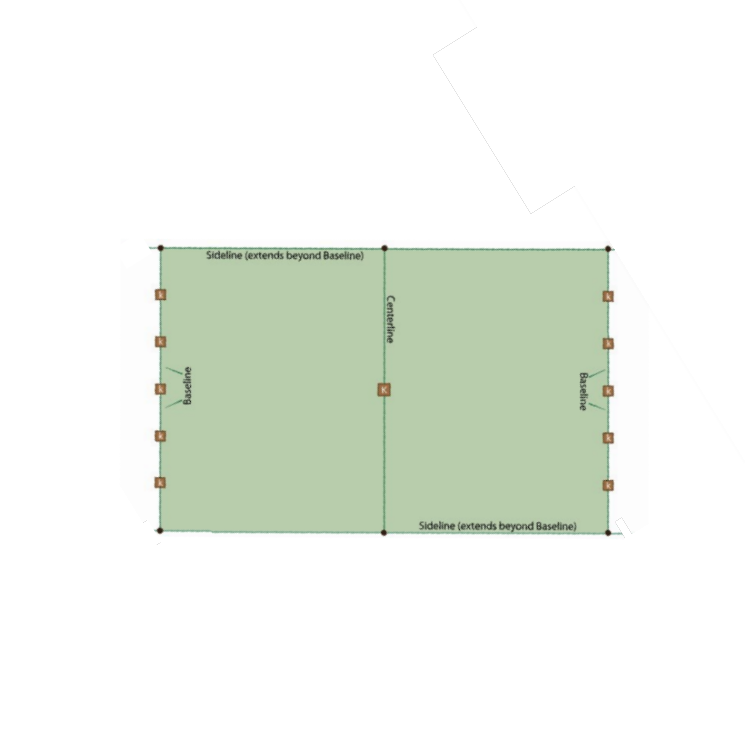
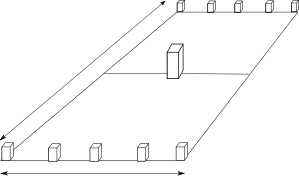
Pitch marking stakes are placed so that a rectangle is formed, with a centerline intersecting the rectangle, and sidelines running on the long edges of the rectangle. The king is placed upright in the center of the pitch, and the kubbs are placed upright on the baselines, five kubbs on each side, equally spaced out no closer than a baton length to the corner stakes. Kubbs starting the game on the baseline are referred to as base kubbs. The baseline should run through the center of the kubbs.
E. Play Overview
- After determining which team throws first and from which side (section II.A), the game begins with the attackers throwing the batons from behind their baseline, attempting to topple the base kubbs on the defenders' baseline. For the first game in a match, the beginning baton throw will be for choosing the side or the throwing order. For the following games (2, 3, 4, 5) teams will alter sides; there will still be a baton throw for these games, but it will be for determining the throwing order.
- Once all the batons are thrown, the opposing team gathers any base kubbs that have been knocked down during the turn, and throws them into the upfield (the far half of the pitch). Kubbs thrown into the upfield are called field kubbs, and are raised by the first team (now the defenders) where they came to rest. The second team (now the attackers) throws the batons; before they aim at the base kubbs, they first need to knock over any field kubbs, then they can aim at the base kubbs, then the king.
- If they are unable to knock down all of the kubbs, then the king, the first team picks up all toppled kubbs — these kubbs are dead and should be placed off to the side. Play then continues to a second round. Rounds continue until the game ends.
- Teams only get one chance (one baton throw) per throwing possession to knock over the king.
The game is won by the team who topples all the kubbs in the upfield and on the baseline, then topples the king. However, if a team topples the king at any time prior to toppling all field and base kubbs, that team immediately loses the game. A match is determined by the winner of best-of-five games.
F. Determining the Winner of a Series
If a game is canceled due to weather or other factors, and it occurs within the first 30 minutes of play, the game concludes as a tie. Beyond this 30-minute mark, the team that is ahead at the time of cancellation is declared the winner of the series. If the series is tied and a game is canceled midway through play, specifically in the case of game 3 or 5, the series is deemed a wash, resulting in a tie.
If both teams win two games (in the five-game series) and there is less than 15 minutes in the hour of play, rather than conducting a full third game, the two teams will compete in a "throw off." The objective of the "throw off" is to be the first team to knock over all of the opposing base kubbs, or to be the team that toppled the most base kubbs when the game time expires. The "throw off" does not require teams to throw kubbs upfield — once a kubb is knocked over, it is pulled off the pitch and declared a dead kubb. The team that won the first game chooses the throwing order or chooses which baseline to defend. You still start with a baton throw towards the king to determine the 2-4-6 open.
If a team holds a 2-1 game lead, the trailing team can still level the series, but must accomplish this outside the final 5 minutes of the hour. Should the series become tied with more than 5 minutes remaining in the game hour, a "Sudden Death" situation ensues: each team receives two rounds of throwing, involving 6 batons each for a total of 12 batons. The match still commences with a baton throw at the king, determining the team that throws first; there is no 2-4-6 open rule. The first team to either topple all of the opposing base kubbs, or hold the upper hand in the number of base kubbs toppled when both teams complete their two rounds of throwing, wins. In the event of a tie after both teams complete their two rounds, the first team to knock down a block secures the win.
If it is tied 1-1 in games and the third game commences but isn't fully completed when time runs out, the team currently in the lead (by number of kubbs knocked down) is declared the winner.
II. In-Depth Phase Rules
A. Determine Sides and Order (Beginning Toss Phase)
Once both teams agree on an accurate setup of the pitch, sides and order are determined by the following rules (done at the beginning of each FULL game):
- Each team chooses one player as a representative and selects a baton.
- The two representatives stand behind opposing baselines facing each other.
- One or both count to 3; on 3 they each throw a single baton according to the rules for throwing batons.
- When the batons come to rest, the team whose baton is judged closest to the king without having knocked it over chooses the throwing order or chooses which baseline to defend. If the winner chooses throwing order, the losing team may choose which baseline to defend, and vice versa. For the first game in a match, this throw is for choosing side or throwing order; for games 2–5, teams alter sides and the throw determines throwing order only.
- The baton may touch the king, but cannot knock it over.
- In the event of a tie, or if the king falls after being impacted by both teams' batons, re-throw until there is a clear winner.
- All games start with the 2, 4, 6 open. The opening team throws only two batons, the second team throws only four batons, and the opening team then throws all six batons. Two different players must throw the two batons, and at least two different players must throw the four batons. After the 2, 4, 6 opening, the rest of the game's throws are in groups of 6.
- For any disagreements on initial baton or side selection, a random method (e.g., coin flip) can be used to decide.
B. Throwing Batons (Baton Tossing Phase)
- Batons must be thrown underarm. The baton does not have to rotate, but if it does, it must rotate end-over-end vertically. If the baton does not rotate, it needs to travel straight with no horizontal rotation from release to impact. Regardless of how thrown, the baton cannot go more than 45° off the vertical plane and must stay within the throwing area.
Note: Throwing Area = the hourglass-shaped area a baton must stay within during the throw to be considered legal. Vertical Plane = the line intersecting the horizon that the Throwing Area must travel on during a throw.
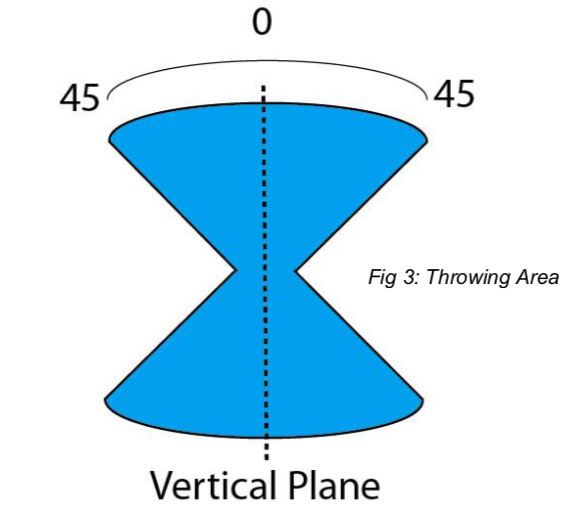
Fig 3: Throwing Area — the hourglass-shaped area a baton must stay within, up to 45° either side of the vertical plane. - Most kubb games are played on grass; here at the Forgotten Star we play on a gravel-like pitch. Our surface allows the baton to slide more than usual, sometimes turning into a roll, which alters the game and creates an unfair advantage. Technically it is not an illegal throw, but teams should aim for the kubb rather than attempting a "slide throw." Accidental sliding will happen every game; if a coordinator or other teams see sliding as a common occurrence, a warning will be given, with further action if the issue continues.
- If the opposing team failed to topple all of their field kubbs on the previous turn, an advantage line is created running parallel to the baselines and through the center of the field kubb closest to the center line. Players may advance to and throw from behind an advantage line.
- Any supporting areas must remain behind the throwing line and between the sidelines throughout the throwing motion, without assistance from other players.
- Multiple kubbs can be toppled from a single baton throw.
- If any base kubbs are toppled and at least one field kubb is still standing, the base kubbs are immediately raised back to their previous locations — they remain base kubbs.
- Only one baton may be thrown at a time.
- If a kubb is struck and, without ever becoming parallel to the ground, is pushed out of legal bounds, it is immediately returned to the location it last was legally in-bounds.
- If a kubb is struck and there is a question as to whether it will fall over, a reasonable amount of time shall be provided to determine the outcome. Kubbs that fall but were not struck by the present throw are placed back in their original position prior to the throw.
- If a kubb is struck and, without ever becoming parallel to the ground, comes to rest leaning on a game component, the attacking team may ask to temporarily halt play. The defending team moves the supporting piece(s) the minimum amount required to determine if the leaning piece will fall, without touching the kubb in question, then resets pieces as close to original position as possible. If a piece falls, it is considered to have toppled for the remainder of the phase.
- A toppled kubb that comes to rest standing on one end (through the course of its motion) is still considered toppled; it is customary to put a token on it.
- If the team attempting to hit the King successfully knocks down an opponent's field kubb in the process, that field kubb is considered "down"/"out."
- If field kubbs located in the attacking team's half of the pitch are hit by the attacking team's batons, those field kubbs (and any toppled kubbs in the opponent's half, and the king on game-ending king throws) are immediately placed back in their previous location, and the baton is forfeited.
- Once all batons have been thrown:
- If the king has been toppled, the game is over.
- If not, the defender may reset any leaning kubbs to vertical, and the game progresses to the kubb tossing phase.
C. Throwing Field Kubbs (Kubb Tossing Phase)
- After the attacking team has thrown all batons, the defending team becomes the attacking team, gathers any kubbs toppled by their opponent, and throws them to the upfield as field kubbs.
- Kubbs may be held and thrown in any manner, but must be thrown with an underarm motion (they may rotate in any direction when thrown).
- Any supporting areas must remain behind the throwing line and between the sidelines throughout the throwing motion, without assistance from other players.
- If a thrown field kubb impacts a previously thrown field kubb, each is raised where it finally comes to rest — it's possible to knock kubbs into and out of play this way. Field kubbs must not be touched by any player until all field kubbs have been thrown.
- This applies to previously established field kubbs from prior rounds too — if impacted by a thrown field kubb, it's raised in its new position and remains a field kubb.
- If the thrown field kubb impacts a field kubb in the thrower's own half of the pitch, the previously standing field kubb is placed back to its original location, and the thrown kubb is considered out of bounds.
- If a thrown field kubb impacts a field kubb in play and the struck kubb comes to rest in a way that it cannot be raised in bounds:
- If the impacted kubb was previously established, it's returned to the attacking team to be thrown, treated as not yet thrown this round.
- If the impacted kubb was thrown once this turn, it's returned to the attacking team to be re-thrown.
- If the resting kubb has already been thrown twice this turn, it becomes a punishment kubb — the team may place it anywhere in the pitch at least one baton's length from the king.
- After all field kubbs have been thrown, any that have only been thrown once and cannot be raised in bounds are returned to the attacking team to be re-thrown.
- For determining whether a kubb is in bounds, judge where the center of the kubb is relative to the center of the boundary — if 50% of the kubb is in, it's declared in bounds.
D. Standing Field Kubbs (Kubb Raising Phase)
- After all field kubbs have been thrown (and re-thrown as necessary), kubbs are raised upon one end while keeping an edge on the ground. The two possible raising locations are called the footprints. If both footprints are unobstructed and in bounds, the defending team may choose which end to raise the kubb on.
- If a thrown field kubb comes to rest on one end and is at least 50% in bounds, it's considered "raised" and must not be moved by the defending team.
- Any field kubb that can be raised in bounds must be raised in bounds.
- Defenders cannot raise kubbs in a manner that forces other kubbs out of bounds when other raising options are available.
- If a field kubb cannot be raised on one end due to obstruction by the king, a pitch marking stake, or another kubb, it must be raised on the unobstructed end.
- If both ends are obstructed and either can be unobstructed by raising another kubb first, the defending team must do so.
- If neither end can be unobstructed, the field kubb may be raised on either end, touching the obstruction, as close as possible to its potential footprint had there been no obstruction. Pitch marking stakes may not be removed to raise a kubb.
- If one end is obstructed and the other is out of bounds, it must be raised on the inbounds end touching the obstruction, as close as possible to its potential footprint. Note: the kubb may end up out of bounds.
- A kubb leaning on another kubb or obstruction is raised upon the end closest to the field. If that end is out of bounds, raise the supporting kubb first, then re-lower and raise the leaning kubb in bounds.
- Any field kubb that comes to rest horizontally on top of one or more other field kubbs is lowered directly to the pitch, touching the lower kubb. Note: Defender chooses which side to lower if both ends are unobstructed and in-bounds.
- If impossible on one end due to obstruction/boundary, it must be done on the unobstructed, in-bounds end. The bottom kubb cannot be moved until the elevated kubb is resolved.
- If impossible on either end due to obstructions, un-raised kubbs must be resolved in a legal manner allowing the elevated kubb to be lowered directly to the pitch.
- Once a player begins raising a kubb on one end, it cannot be laid back down to be raised on the other end, barring temporary standing to determine in/out of bounds.
- Kubbs raised by the defending team must be self-supported — raised kubbs cannot be supported by another game component.
- Reasonable and essential force is allowed to push or tamp on a kubb to create self-support.
- Twisting a kubb is never allowed.
- Debris from the pitch may be cleared prior to raising a kubb, but altering the natural state of the pitch is not allowed (moving a twig is legal; pulling grass is illegal).
- Debris may not be used to create nonessential support to a kubb.
- Kubbs that come to rest on their long edge (no corner supported by the ground) are flattened in an unobstructed, in-bounds direction closest to the pitch (with gravity) before being raised. If the long edge is completely vertical, the defending team chooses which way to flatten. Flattening against gravity to make the kubb in-bounds is not allowed — except when a kubb rests on its long edge in contact with another game component such that the unobstructed direction is both with gravity and out-of-bounds; in that specific case, once the supporting field kubb is raised, the kubb may be flattened against gravity to make it in-bounds if possible.
- If a field kubb thrown twice comes to rest such that it cannot be raised in bounds, it becomes a punishment kubb. Punishment kubbs are collected by the defending team and placed anywhere on their half of the pitch, at least one baton-length (30cm) from the king and at least one baton-length from any pitch marking stake.
III. Rules Enforcement
A. Etiquette and the Spirit of the Game
- Kubb is a game that expects high standards of etiquette and courtesy — concern for spectators and other players, and respect for the tournament coordinator's direction and officials' decisions.
- These rules are designed to promote a fair and enjoyable environment for all kubb players, regardless of age, sex, or ability. The spirit of the game — good sportsmanship, courtesy, and honorable conduct — takes precedence and should influence both the interpretation of the rules and the conduct of participants.
B. General Rules
- Some phases and situations in kubb can be complicated and potentially indefinable by any ruleset. If a situation isn't covered here, the decision is made in accordance with fairness and the spirit of the game, often by logical extension of the closest existing rule.
- Unless stated otherwise, rules are enforced by the league/tournament coordinator, who enforces all penalties. Penalties: Warning, Game Penalty, Match Penalty, and Personal Ejection.
- Warning: a verbal warning to the team; may be issued more than once for repeated infractions at the referee's discretion.
- Game Penalty: one baton is forfeited for the remainder of the game. Cannot be given without a prior Warning.
- Match Penalty: one baton is forfeited for the remainder of the match (best of five games).
- Personal Ejection: the player may not continue tournament/league play. If this drops a team below two active players, the team forfeits all remaining games and is disqualified. The ejected player may be banned from future kubb tournaments/leagues.
- The team captain may call for a coordinator to provide oversight during a game; play halts until the coordinator allows it to continue.
- The coordinator can enforce rules at any time before, during, or after a tournament/league game, and does not need to be called upon to assign penalties.
- Any rule enforced during a throwing phase against the non-throwing team results in a replay of the last thrown game component, if requested by the throwing team — reset to positions prior to the last throw and replay it.
- Any rule enforced against the throwing team (including warnings) during a throwing phase results in forfeiture of the last toss — reset game components to prior positions, and kubbs thrown on the forfeited toss are removed from play and treated as thrown out of bounds.
- When an illegal action is taken that is not a penalty and can be reversed with no change to game state, play halts until it is corrected. Examples: picking up an un-toppled kubb to rethrow, unintentionally kicking over a baseline kubb, or throwing only 5 batons after a kubb has been thrown by the opposing team.